Skip to content

Free Chicago planning tool

Group Size Calculator: How Many Seats to Request

The number of people you invite is almost never the number who board. This calculator takes your invite list, applies the share you expect to show up, adds room for late additions, and optionally pads the result by about 15 percent for comfort. The output is a single seat target plus the vehicle size band it falls into, from a small limo Sprinter up to a full-size coach or more than one vehicle.

Written quote before deposit
Vehicle and operator details confirmed
Route timing and stop plan reviewed
Sound system and lighting options vary by vehicle
BYOB policies confirmed by event type
Stops planned within reserved time
Read 29 dated customer comments✓ Online quote request anytime✓ Serving All of Chicagoland

Get Your Free Quote

Pickup ZIP, date, headcount, and hours get you one written total with the driver, fuel, taxes, and gratuity included.

Or call 1-773-570-7445partybusexperts@gmail.com

Group Size Calculator

Turn an invite list into a realistic passenger count and see which vehicle size band to request.

Count everyone who would ride, including you.

85%

Plus-ones, a cousin in town, a coworker who decides late.

Your seat target

Expected passengers21
Seats to request21

21–30 seats: mid-size party bus

Large enough that one bus is usually simpler than two smaller vehicles. Confirm the loading zone can take a vehicle of this length.

Compare: 24-passenger party bus · 30-passenger party bus

Rated capacity is a legal maximum, not a comfort rating. Never plan to exceed it, and confirm the figure for the assigned vehicle on your written quote.

Runs in your browser with no account. Results are planning aids, not a quote or a reservation. When the numbers look right, send them with a quote request or call 1-773-570-7445.

How to use the group size calculator

That seat target drives most of the other decisions. It sets which vehicles you can be quoted on, how much each person owes, and whether the vehicle can physically reach the curb you have in mind. Request too few seats and someone is left on the sidewalk, because rated capacity is a legal limit.

  1. Enter People invited. The field starts at 24 and accepts 1 to 500. Count everyone who would ride, including yourself and the guest of honor.

  2. Set Share you expect to come with the slider. It starts at 85% and moves in 5-point steps from 50% to 100%. Use 100% if people have already paid or confirmed.

  3. Enter Late additions to allow for, which starts at 0. This is a flat number of seats added after the attendance math, for plus-ones and people who decide late.

  4. Tick the breathing room box if the group will be in formalwear, carrying coolers or luggage, or riding for a long stretch. It multiplies the expected count by 1.15 and rounds up.

  5. Read Expected passengers and Seats to request, then the size band beneath them. Each band links to fleet pages in that range so you can compare layouts.

  6. Use the seat target when you request a quote, and confirm the rated capacity of the assigned vehicle on your written quote.

Our booking-network data

What inquiry data says about this decision

Figures from 65,687 quote-request inquiries across the national booking network we belong to. They describe inquiries, not completed trips, and are not specific to Chicago.

25%

Across 19,506 inquiries for 11–20 passengers for 2024–2025 event dates, 25% were received 14–29 days before the event.

85%

vs 54% across all inquiries

Among inquiries for 11–20 passengers for 2024–2025 event dates, 85% of usable vehicle-capacity entries fell in the 11–20-passenger band; the full-dataset baseline was 54%, a difference of 31 percentage points higher.

1%

vs 18% across all inquiries

Among inquiries for 11–20 passengers for 2024–2025 event dates, 1% of usable vehicle-capacity entries fell in the 1–10-passenger band; the full-dataset baseline was 18%, a difference of 17 percentage points lower.

21%

vs 26% across all inquiries

Among inquiries for 21–30 passengers for 2024–2025 event dates, 21% were received fewer than 14 days before the event; the full-dataset baseline was 26%, a difference of 6 percentage points lower.

Source: 65,687 group-transportation inquiry records with 2024–2025 event dates, collected across the national booking network that Chicago Party Bus Fun is part of. These are quote requests — not completed trips, unique customers, or Chicago-only figures. How we measure this

Why the invite list and the head count drift apart

A group chat with 30 names in it is a guess, not a manifest. The attendance slider exists because the drop-off is predictable enough to plan around. For a Saturday birthday where nobody has paid yet, 80 to 85 percent is a reasonable starting assumption. For a wedding party or a prom group where parents have already committed money, use 95 or 100 percent, because those riders are not optional.

The calculator rounds the expected count up rather than to the nearest whole number. Twenty-six invited at 85 percent is 22.1 people, and the tool calls that 23. The reasoning is simple: a seat you did not need costs a little, while a seat you needed and did not have ends someone's night at the curb.

The most reliable way to tighten the estimate is to stop guessing. Send a quick group poll with a firm reply date, or collect each person's share before you book. Once money has moved, set the slider to 100 percent and let the late additions field handle the rest.
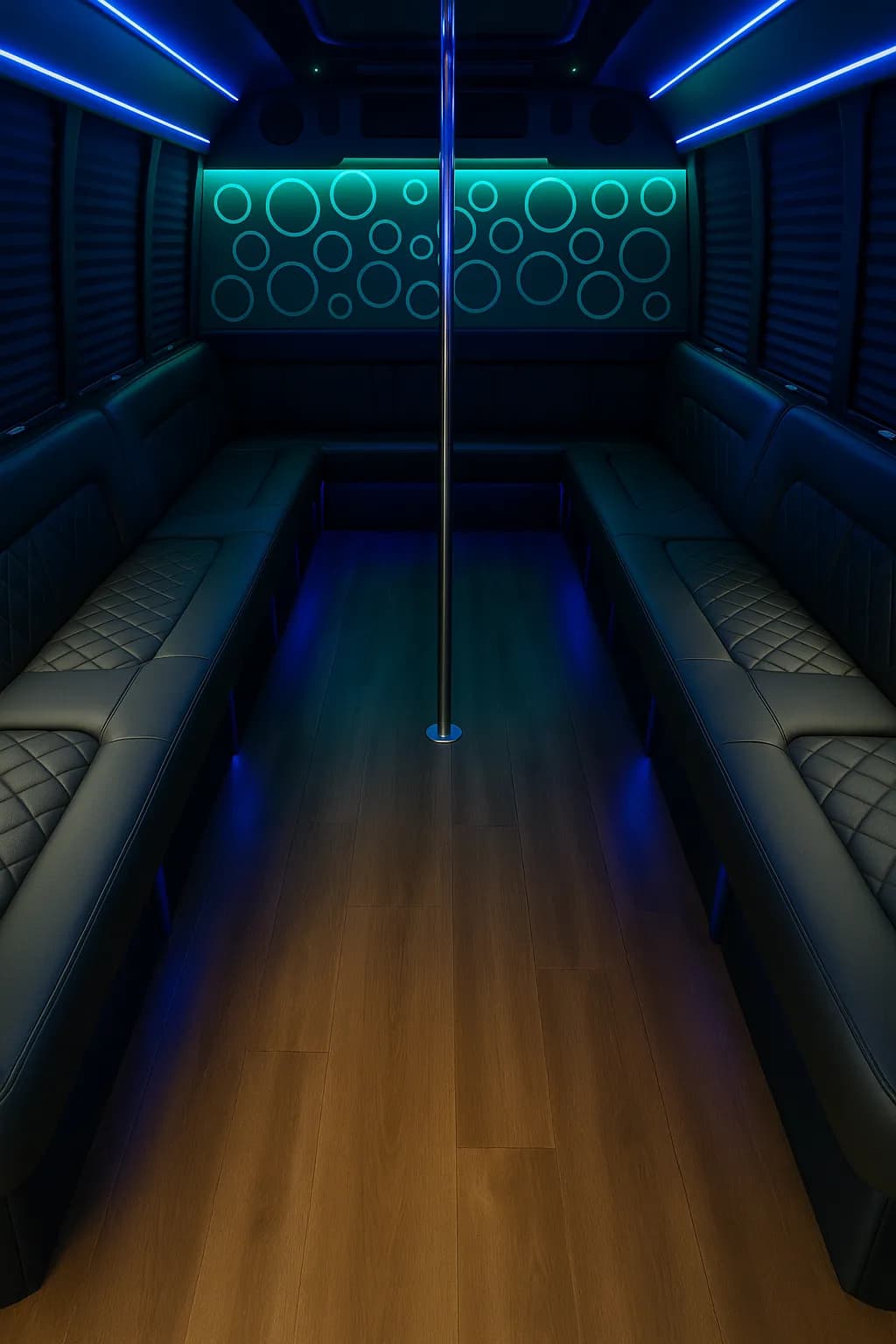
Perimeter seating in a 20-passenger party bus, the size band most groups start with
Perimeter seating in a 20-passenger party bus, the size band most groups start with. Representative photo; confirm the assigned vehicle with your written quote.

Rated capacity versus how adults actually sit

A vehicle's rated capacity is the maximum number of passengers it may legally carry. On perimeter bench seating, the kind found on most party buses, the rating assumes people sitting shoulder to shoulder along the full bench. Twenty adults in winter coats occupy more bench than twenty adults in July, and a Chicago trip between November and March usually means parkas, scarves, and bags that end up on the seat next to their owner.

That is the purpose of the breathing room checkbox. It earns its place in a few specific cases: formalwear that should not be crushed, such as gowns for a quinceañera or a wedding party; coolers and bags on an adults-only BYOB outing, where the cooler takes floor space; luggage on a transfer; and rides longer than about 45 minutes, where being wedged in stops being funny.

Whatever the tool suggests, ask for a current interior photo of the assigned vehicle with your quote, and confirm the rated figure in writing. Never plan to load more people than that number. A driver can refuse to move an overloaded vehicle, and that decision is the right one.

What each size band means on Chicago streets

Seat count changes the vehicle's length, and length decides where you can load. A 10 to 14 seat limo Sprinter is about the size of a delivery van. It can pull up on a narrow one-way block in Wicker Park or Lincoln Park, where parked cars line both sides and there is rarely an open curb. A 30-passenger party bus needs a real loading zone, a hotel driveway, or a corner with room to swing. A 56-passenger coach needs all of that plus a route without tight turns or low clearances, which is why large groups often meet at a hotel on a wide arterial instead of at someone's apartment.

This matters when the calculator puts you near a boundary. If you land at 21 seats, you have crossed from the small party bus band into the mid-size one, and the pickup plan may need to change with it. Often the better answer is a firmer head count that brings you back to 20. For the biggest groups, compare a 45-passenger party bus with a forward-facing coach.
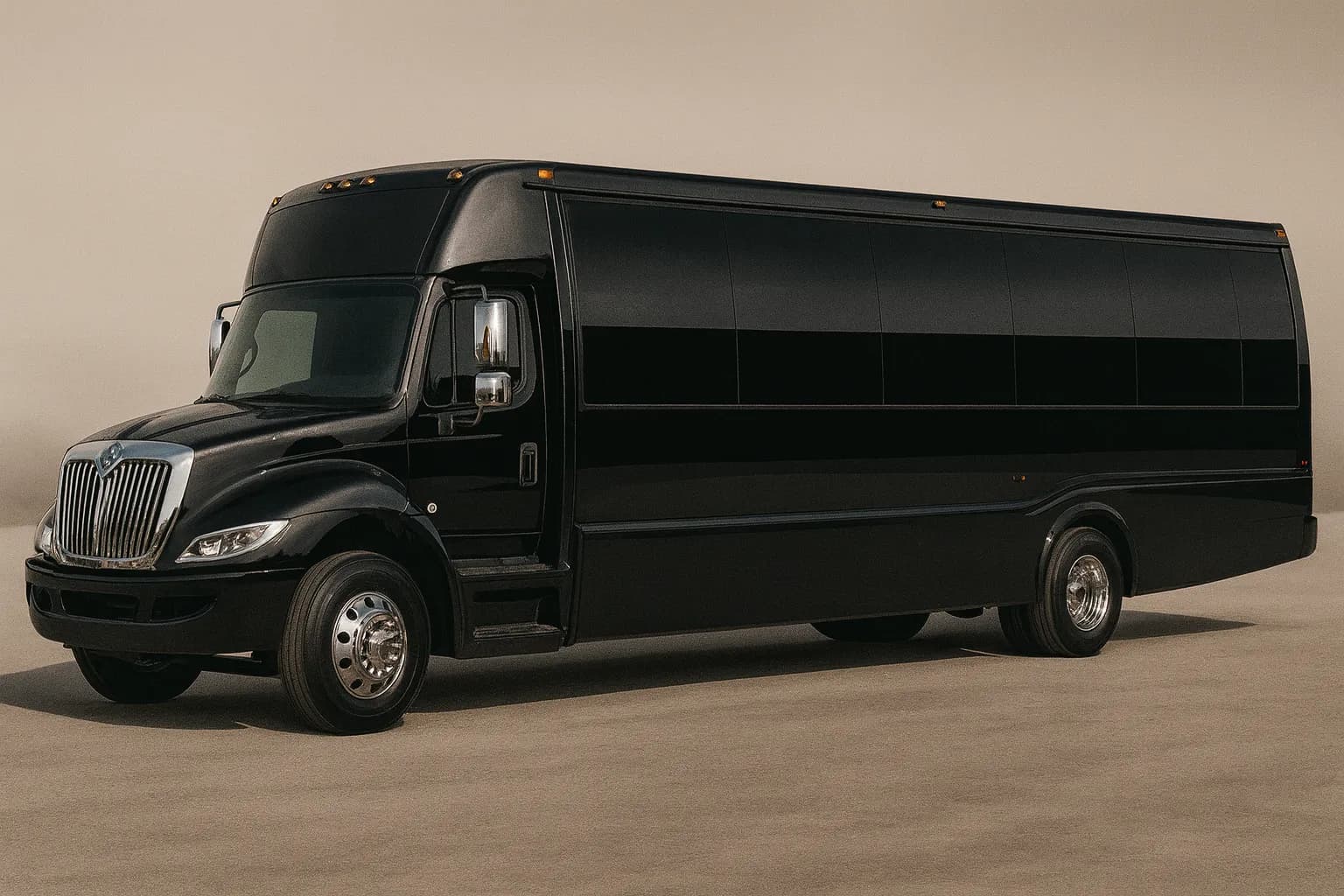
Exterior of a 30-passenger party bus parked curbside
Exterior of a 30-passenger party bus parked curbside. Representative photo; confirm the assigned vehicle with your written quote.

Where most groups land, and what that means for timing

Across 65,687 non-spam inquiry records for 2024–2025 event dates in the national booking network this company belongs to, 49% of usable passenger counts fell in the 11–20 passengers band. That is a dataset of quote requests from around the country, not a record of completed rides, and it is not specific to Chicago. Still, it points to a practical reality: if your seat target is between 11 and 20, you are asking for the same class of vehicle as about half of everyone else who is asking.

The same dataset shows that only 4% of usable passenger counts fell in the 31–40 passengers band. Fewer people ask for that size, but fewer vehicles of that size exist, so a large group has less room to be flexible on date. In both cases the takeaway is to settle the seat target early and ask early, especially for Friday and Saturday dates in prom season, late spring wedding weekends, and December.

You can read how these figures are compiled and what they leave out on the methodology page.
Worked example

Worked example: a 30th birthday leaving from Logan Square

Say you have invited 32 people to a birthday night that starts in Logan Square and heads to River North. Nobody has paid yet, and a few are traveling in from out of town, so you set the attendance slider to 80%. The tool multiplies 32 by 0.80 to get 25.6 and rounds up to 26.

Two friends have asked about bringing partners, so you enter 2 under late additions. Expected passengers is now 26 + 2 = 28.

It is January, people will be in heavy coats, and the group is 21+ and bringing a cooler, so you tick the breathing room box. The tool multiplies 28 by 1.15 to get 32.2 and rounds up to 33. Seats to request: 33.

That puts you in the 31–40 band, a large party bus, with links to the 36- and 40-passenger pages. Without breathing room you would have been at 28, in the 21–30 band. That gap is worth a conversation: get firm replies, and if the real count is 26, a 30-passenger vehicle may fit well.

Seating polls

Vote to see how other groups answered. One vote per poll, no sign-up, and nothing personal is stored.

What is your favorite seating for city walking tours?

What is your favorite seating for city walking tours?

No votes yet — be first

Which type of seating do you prefer in a public library?

Which type of seating do you prefer in a public library?

No votes yet — be first

What seating do you prefer for a city rooftop party?

What seating do you prefer for a city rooftop party?

No votes yet — be first

Group Size Calculator: questions and answers

Straight answers from the Chicago booking desk

What attendance percentage should I use?
Use 100% when riders have already paid or when the ride is part of a formal event, such as a wedding party. Use 85% to 90% for a planned birthday or bachelor night with verbal confirmations. Drop to 75% or 80% for a casual open invite, a weeknight, or a date in deep winter, when colds and weather thin the group.
Does the calculator count children or the guest of honor differently?
No. Every rider is one seat, whatever their age or whether they are paying. Include the guest of honor in the invited count. If you are splitting the cost and someone rides free, handle that in the budget calculator, which has a separate field for the number of people paying.
Can we fit one or two extra people if the bus looks roomy?
No. The rated capacity on your written quote is a legal maximum for that vehicle, and the driver is within their rights to refuse to move with more people aboard. If there is a real chance of extra riders, put them in the late additions field now and request the larger seat count. Paying for two unused seats is a far smaller problem than leaving two friends behind.
When should I tick the breathing room box?
Tick it when people or their things will take more space than a bare head count suggests. Common cases are formalwear, heavy winter coats, a cooler and bags on an adults-only BYOB outing, luggage on an airport or hotel transfer, and rides longer than about 45 minutes. The box adds roughly 15 percent and rounds up, so on a group of 20 it adds three seats.
What if my seat target is more than 56?
The tool tells you how many vehicles to plan for, based on 56 seats per full-size coach. A group of 90, for example, shows two vehicles. Give each vehicle its own named contact and a rider list, so that nobody is counted twice or missed at the end of the night. For recurring loops between a hotel and a venue, the wedding transportation planner handles that math.
My result sits right on the edge of two size bands. Which do I request?
First try to firm up the count, because a real number beats a better guess. If it stays on the edge, think about the pickup location and the season. A smaller vehicle is easier to load on a tight residential block, which favors rounding down only if your count is truly confirmed. Winter coats, formalwear, or a long ride favor the larger band.
How late can I change the passenger count?
That depends on the operator's terms, so ask before you book and look for it on your written quote. In general, reducing the count is easy, since the vehicle simply has spare seats. Increasing it is the hard direction, because the assigned vehicle may already be at its rated capacity and a larger one may not be free on your date. Build the cushion in at the start.
Should I book one large vehicle or two smaller ones?
One vehicle keeps the group together, which is usually the point of the night, and it means one pickup plan and one driver to coordinate with. Two smaller vehicles can make sense when pickups are in different parts of the city, when the streets at either end are tight, or when the group naturally splits. Use the vehicle comparison tool to see how the types differ, then ask for both options on your quote.

Ready for real numbers? Request a written quote

Tell us about your event and ask for a written quote. If your reservation is serviced by an affiliate or sister company, confirm vehicle, operator, base rate, minimum hours, and included charges with that provider before paying a deposit.

Or call 1-773-570-7445 • Email partybusexperts@gmail.com

Call NowFree Quote